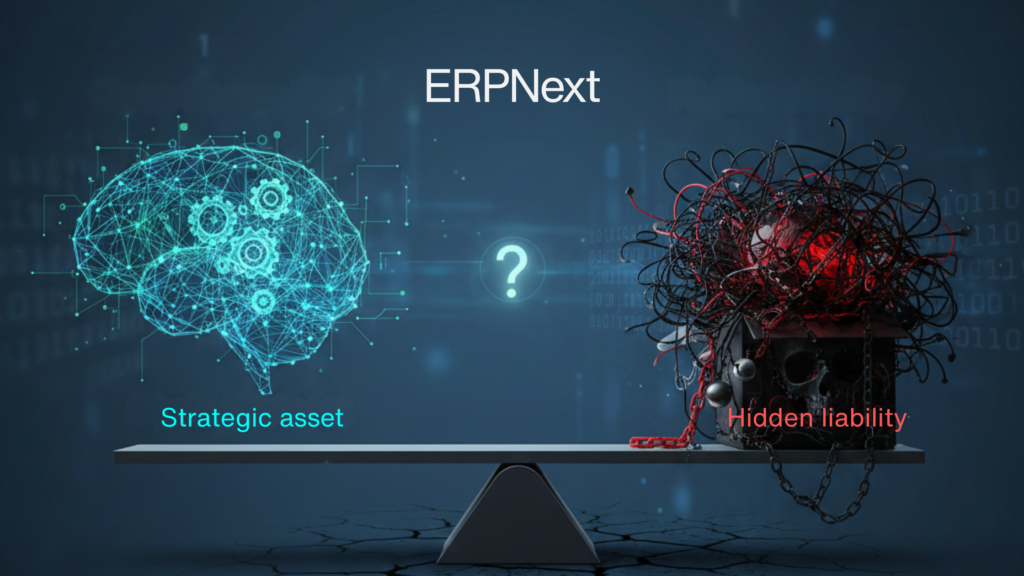
Open-Source ERP: Strategic Asset or Hidden Liability?
The enterprise software landscape is shifting beneath our feet. While legacy vendors continue raising maintenance fees, a quiet revolution is unfolding: open-source ERP is moving from IT experiment to boardroom strategy.
The ERPNext Signal
Consider ERPNext an open-source platform now powering over 10,000 companies globally, from manufacturing to healthcare. What started as an alternative for cost-conscious mid-market firms has evolved into a serious contender for enterprise deployment.
The numbers demand attention. When evaluating open source ERP vs traditional ERP, organizations migrating to ERPNext report 50-70% reduction in software licensing costs compared to SAP or Oracle.
But the strategic value of enterprise open-source ERP goes deeper:
- Complete data ownership with no vendor control
- API-first architecture that integrates seamlessly with AI and analytics tools
- Customization velocity that proprietary systems simply can’t match
Real-world deployments span diverse sectors:
- Manufacturing companies managing complex supply chains
- Healthcare providers building patient management systems
- Retail chains running omnichannel operations
All on an open-source foundation that adapts to their digital transformation roadmap, not a vendor’s.
The Governance Reality
Yet executive caution is warranted. ERPNext’s flexibility is also its challenge. You’re not buying a finished product , you’re buying strategic control with implementation responsibility.
Who owns system stability when there’s no traditional enterprise SLA? Most successful enterprise open-source ERP deployments pair the open-source core with commercial support from Frappe (the core maintainers) or specialized implementation partners. This hybrid model works, but requires different procurement thinking and risk management than traditional enterprise software.
Integration capability becomes your competitive advantage or your bottleneck. Your team needs talent who understand both ERPNext’s Python-based architecture and your business processes. That’s a different skill profile than SAP consultants, and in today’s talent market, a genuine consideration.
The Decision Framework
The open source ERP vs traditional ERP decision comes down to strategic fit. Open-source ERP like ERPNext is a strategic asset when you have:
- Technical capability and development resources
- Clearly documented processes
- Organizational willingness to own the platform
- Need for API access and data control (especially for AI-enabled operations)
It remains a hidden liability when leadership:
- Underestimates the capability transformation required
- Views it purely as cost arbitrage
- Lacks the technical talent to sustain it
The question isn’t whether enterprise open-source ERP is “the future.” It’s whether it’s the right strategic choice for your specific context: your industry complexity, technical maturity, growth trajectory, and risk appetite.
The open source ERP vs traditional ERP debate isn’t about which is universally better , it’s about which model aligns with your organization’s strategic capabilities and risk tolerance.
What’s your take? Are we seeing a genuine shift in enterprise software ownership models, or is this just cost optimization dressed up as strategy?
Navigating this decision in your organization? Happy to exchange notes