Why Construction Companies Are Moving Towards ERP Systems
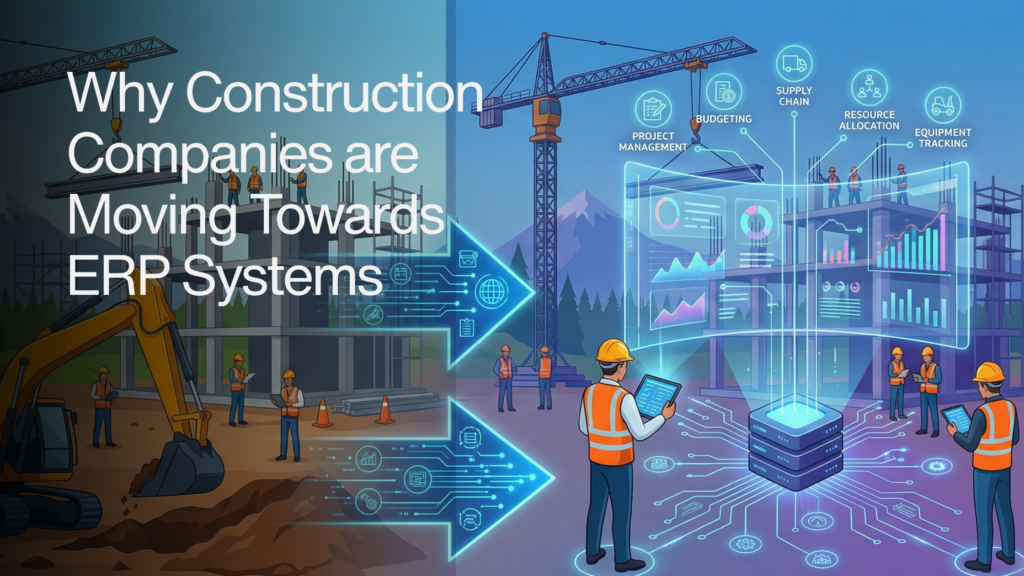
Construction projects today are more complex than ever, involving multiple sites, teams, vendors, and cost variables.
Yet many companies still rely on spreadsheets, emails, and disconnected tools to manage operations. While this may work in the early stages, it often leads to delays, cost overruns, and a lack of visibility as projects grow.
This is where ERP for construction comes in.
Key Features of Construction ERP
A well-implemented ERP for construction companies typically includes:
- Project cost tracking (budget vs actual)
- Procurement and vendor management
- Inventory and material tracking
- Financial integration and accounting
- Real-time dashboards and reporting
These features make ERP for construction essential for teams that want better coordination and faster decision-making across projects.
Why Are Companies Moving Towards Construction ERP?
The shift towards ERP is driven by the growing limitations of traditional systems like spreadsheets and disconnected software.
Common challenges include:
- Too many manual processes and scattered data
- Delayed or inaccurate reporting
- Lack of real-time cost visibility
- Poor coordination between departments
- Difficulty tracking overall project profitability
Many teams we interact with at TechfordAI highlight similar challenges — especially around cost visibility and disconnected workflows.
As construction businesses scale, these issues become harder to manage.
This is why more companies are adopting ERP for construction to centralize data, automate workflows, and gain real-time insights enabling a shift from reactive to proactive decision-making.
Benefits of Construction ERP for Growing Companies
Companies adopting construction ERP systems often see measurable improvements:
- Better control over project costs
- Reduced financial leakages
- Improved coordination across teams and departments
- Faster, data-driven decision-making
- Increased overall project efficiency
Construction challenges don’t usually start on-site — they start with limited visibility into costs, procurement, and execution.
When Should a Company Consider Construction ERP?
A construction company should consider ERP when:
- Managing multiple projects simultaneously
- Experiencing frequent cost overruns
- Using disconnected tools or manual processes
- Struggling with timely and accurate reporting
These are strong indicators that existing systems are no longer scalable.
Conclusion:
As construction projects grow in complexity, relying on disconnected systems is no longer sustainable.
Construction ERP provides a structured and integrated approach to managing operations, helping companies improve visibility, control costs, and operate more efficiently.
For many growing construction businesses, adopting ERP is becoming a necessity rather than an option.
If this is something your team is exploring internally, we’d be happy to share some of the practical approaches we’re seeing across construction companies.